
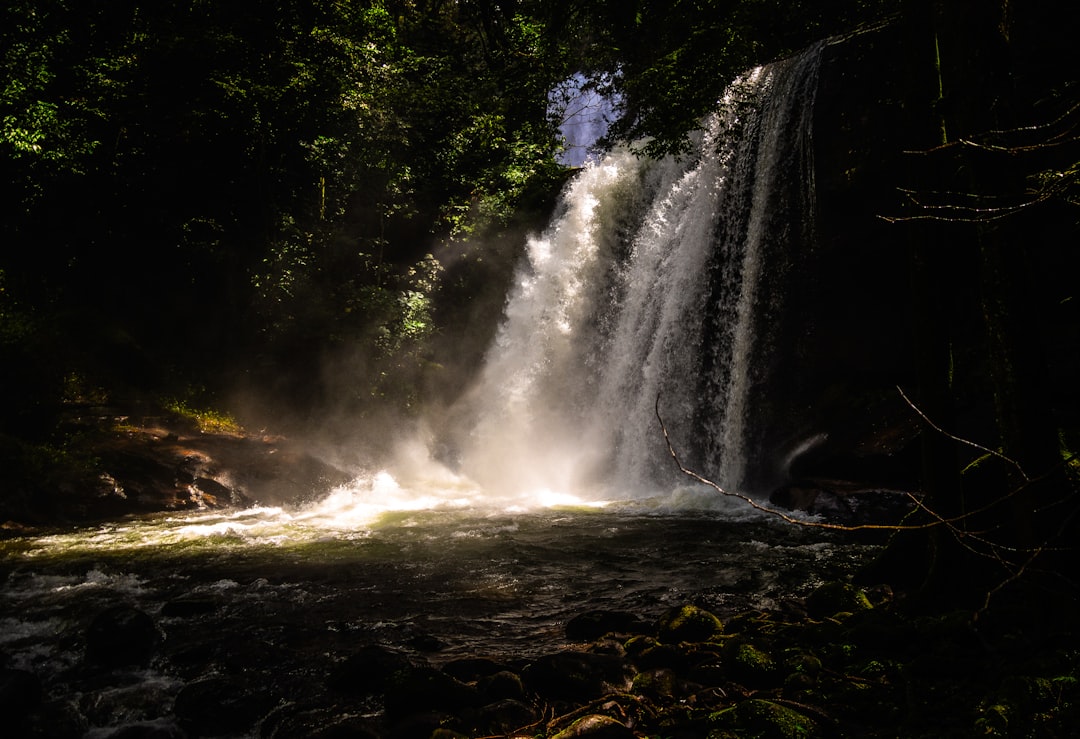
Phophonyane Falls Nature Reserve
Ten kilometres north of Piggs Peak — an 80-metre waterfall over rocks dated at 3.55 billion years old. Subtropical forest, 240+ bird species including the Narina Trogon, and the acclaimed Phophonyane Ecolodge.
Ancient Rock and Forest
Photo by Michael Starkie on Unsplash
About Phophonyane Falls Nature Reserve
Ten kilometres north of Piggs Peak, a 600-hectare private reserve protects a forest of unusual geological and biological significance. The 80-metre Phophonyane Waterfall tumbles over ancient exposed bedrock in a series of cascading rapids — and the rock over which it falls has been dated at 3.55 billion years old, making these among the oldest exposed geological formations on the surface of the earth. The Gobolondlo forest surrounding the falls is lush, subtropical, and densely inhabited. Troops of banded mongooses and vervet monkeys move through the understorey. The red duiker — shy and small — appears and disappears in the undergrowth.
Over 240 bird species have been recorded within this compact reserve, and the most coveted of them, the Narina Trogon, an elusive bird of brilliant green and crimson, serves as the reserve's emblem. The combination of subtropical forest, waterfall spray zone, and varied terrain within a compact 600 hectares produces exceptional bird diversity for a private reserve. Beyond the Trogon: kingfishers, sunbirds, barbets, warblers, and the full complement of forest and riverside species make Phophonyane one of the best birding locations in the northwestern highlands.
Walking the trail to the waterfall base and standing on the ancient bedrock — understanding that this specific rock surface formed when the earth was less than a quarter of its current age, when no multi-cellular life existed anywhere — produces a specific quality of perspective. The waterfall is beautiful. The rock it falls over is extraordinary. Phophonyane Falls Ecolodge operates as the basecamp for exploring this remarkable environment: chalets and tented accommodation positioned in the forest, walking trails radiating from the lodge, and access to the falls via short trail. It is the smallest and most overlooked of Eswatini's major reserves. It rewards the birder, the botanist, the geologist, and the traveller who simply wants a forest morning with a waterfall at the end of it.
Things to Do in Phophonyane Falls Nature Reserve
Hike to the Phophonyane Falls
Short well-marked trail from the ecolodge to the waterfall base. Standing on bedrock dated at 3.55 billion years old as 80 metres of water falls through the forest is the defining Phophonyane experience.
Search for the Narina Trogon
The reserve's flagship bird, brilliantly coloured and deeply reluctant to be seen, rewards patient quiet early-morning searching along the forest trails near the falls. An experienced birding guide from the ecolodge significantly improves encounter rates.
Mountain bike the reserve trails
Phophonyane offers mountain biking through specific trails within the 600-hectare reserve. The terrain mixes forest and open sections; moderate fitness required. A different physical engagement with the landscape.
Bird the wider forest and waterfall margins
Beyond the Trogon: kingfishers, sunbirds, barbets, warblers, and the full forest-and-riverside species suite. Over 240 species recorded. Bring binoculars and a bird guide. Morning hours are most productive.
Walk to the rock pools
Beyond the main falls, additional swimming holes and cascade pools are accessible on the reserve's trail network. Safe swimming spots are clearly marked by the ecolodge. A refreshing addition to the forest walking.
Combine with Maguga Dam and Malolotja
The northern Eswatini circuit pairs Phophonyane with Maguga Dam (15 minutes north) and Malolotja Nature Reserve (30 minutes south) for a full highlands itinerary. 2-3 days covers the wider northern highlands.
When to Visit Phophonyane Falls Nature Reserve
Wet Summer
November, March
Migratory birds arrive in extraordinary numbers; the Narina Trogon is most active. The falls reach maximum volume. Forest vegetation peaks. Hot daytime temperatures; afternoon thunderstorms common but the forest canopy provides shelter.
Cool Dry
May, August
Mild conditions for the forest trails. Falls flow moderate but still impressive. Resident bird species at their most concentrated; the broader Pigg's Peak area is comfortable for combined exploration.
Shoulder
April, October
Tail end of the rains (April) or first dry-season visibility (October). Pel's fishing owl viewing peaks; birding is strong. Lower visitor numbers; lodge pricing favourable.
Hot Dry
September, November
Pre-rains dry period. Falls flow at its weakest; the geological detail (the 3.55-billion-year-old rocks) is most exposed. Hot daytime; cooler in the forest. Less popular but offers a specific landscape experience.
Getting to Phophonyane Falls Nature Reserve
By road from Mbabane: approximately 80 km north on the tarred MR1 highway (1.5 hours) through Pigg's Peak. From the Ngwenya border with South Africa: approximately 90 km (1.5 hours). From the Matsamo border: approximately 30 km (40 minutes), the closest international entry. The reserve entrance is signed off the MR1 north of Pigg's Peak. Internal reserve roads are dirt tracks suitable for standard sedans in dry conditions; 4WD adds margin in wet season.
Where to Stay
Phophonyane Falls Ecolodge is the principal property. Stone-and-thatch chalets and tented accommodation in the forest; substantial private decking; lodge restaurant. Among Eswatini's most atmospheric small lodges. The ecolodge operates the reserve trails and birding programmes. There are limited alternative properties at Phophonyane itself; visitors wanting mid-range alternatives stay at the Pigg's Peak area lodges and day-visit the reserve.
Travel Tips for Phophonyane Falls Nature Reserve
Frequently Asked Questions
- Will I see the Narina Trogon?
- With effort, yes — the species is reliably present at Phophonyane and is one of the better destinations in southern Africa for it. Patient quiet early-morning searching with an experienced guide produces encounters on a meaningful fraction of stays. Not guaranteed but very achievable.
- How long should I stay at Phophonyane?
- Two nights covers the reserve thoroughly — one full day for the falls and trail network, plus additional time for birding and the wider area. Many visitors combine 1-2 nights at Phophonyane with the broader northern Eswatini circuit (Maguga, Malolotja).
- Is the geology really 3.55 billion years old?
- Yes — the rocks of the Archaean greenstone belt that surface at Phophonyane are among the oldest exposed geological formations on the surface of the earth. The reading dates rocks of similar formation across the region; Phophonyane provides direct access to the surface exposure.
- Is Phophonyane suitable for families?
- Yes. The short trail to the falls is achievable for fit children; the forest walks are interesting for young naturalists. The ecolodge is family-friendly. Birding can engage older children with binoculars.
Explore More, Phophonyane Falls Nature Reserve
Things To Do
Plan Your Trip
More in Eswatini
Mlilwane Wildlife Sanctuary
Eswatini's oldest protected area and the only southern African destination where visitors can walk, cycle, and horseback ride directly throu…
Hlane Royal National Park
Eswatini's largest national park, home to exceptional white rhino densities, elephants, lions, and the legendary Ndlovu Camp floodlit waterh…
Malolotja Nature Reserve
44,000 acres of pristine afromontane wilderness — the canopy tour, 89-metre Malolotja Falls, 12 globally threatened bird species, ancient cy…
Mkhaya Game Reserve
Strictly guided, exclusively accessed — Mkhaya's tightly controlled model delivers the highest-certainty black and white rhino encounters in…
Mantenga Cultural Village
A meticulous reconstruction of a 19th-century Swazi homestead, inhabited by community members who perform daily traditional activities. Dail…
Ezulwini Valley & Lobamba
Eswatini's cultural, spiritual, and logistical centre. The corridor between Mbabane and Manzini holds Lobamba (the spiritual capital), the S…
Maguga Dam
A scenic reservoir on the Komati River in the Hhohho region — panoramic valley views, boat cruises, and the start of the MR1 craft corridor …
Malkerns Valley
The fertile agricultural valley south of Ezulwini hosting Swazi Candles, Gone Rural, Baobab Batik, and the annual MTN Bushfire Festival. Dir…
Shewula Mountain Camp
Eswatini's pioneering community eco-tourism project on the Lubombo escarpment. A 100-kilometre panorama across the lowveld into Mozambique, …