
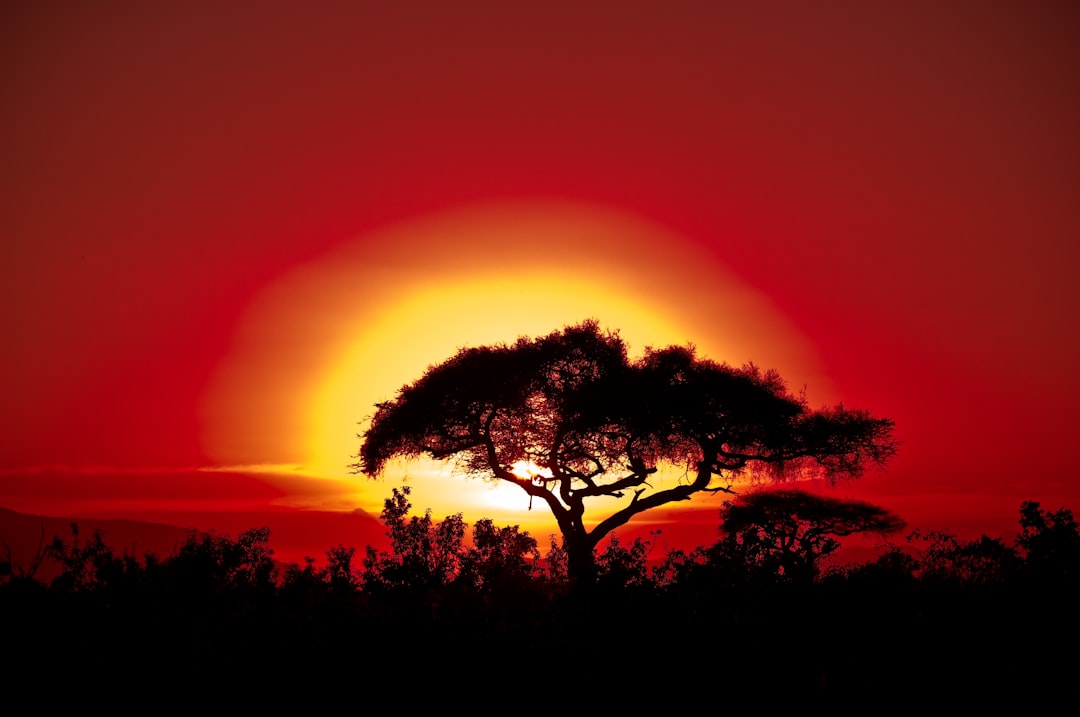
Nxai Pan National Park
A fossil lakebed adjacent to the Makgadikgadi with open terrain ideal for cheetah hunting and the ancient cluster of baobabs painted by Thomas Baines in 1862 — unchanged 160+ years later.
Baines' Baobabs and Open-Pan Cheetah Country
Photo by Florian Berger on Unsplash
About Nxai Pan National Park
Adjacent to the Makgadikgadi system, Nxai Pan National Park covers 2,578 square kilometres of fossil lakebed blanketed in short, sweet, nutrient-dense grasses that draw herbivores immediately following the summer rains. The flat, open pan provides unobstructed sightlines in every direction — the best terrain in Botswana for watching cheetah hunt at full speed. When the green-season migration arrives, the predator-prey dynamics unfold on a stage designed for visibility.
Baines' Baobabs — a striking cluster of seven ancient trees immortalized in paintings by explorer and artist Thomas Baines in May 1862 — stand exactly as he painted them, unchanged and unchanged-looking: bulbous, enormous, impossibly old. Baines was on a Zambezi exploration when he stopped at the grouping to sketch and paint; the works survive in archives in South Africa. Comparison with photographs taken from identical positions today shows the trees in essentially the same configuration. The bark scars Baines recorded are still visible. The continuity of the image, the same trees, the same silhouette, 160+ years later, is quietly extraordinary.
Nxai Pan operates on a sharply seasonal calendar. December-April is the green-season peak — wildlife densities rival anywhere in the country, cheetah encounters are at their most spectacular, and the migration herds are present. May-November is the dry season — wildlife disperses, the pan is empty, the experience shifts toward landscape immersion and the dawn light on the baobabs. Both seasons have their merits; visitors should be clear which one they are travelling for. Most visits combine Nxai with the adjacent Makgadikgadi for a 4-5 night Kalahari-pan circuit. Standalone Nxai stays are unusual; 2-3 nights as part of a wider circuit is the standard format.
Things to Do in Nxai Pan National Park
Track cheetah on the open pan
The signature green-season activity. Resident and dispersing cheetah hunt the open pan; guides position for morning and late-afternoon hunting windows. The open terrain means you see the entire sequence: the stalk, the lock, the burst to 110 km/h, the outcome. One of Africa's most spectacular short-duration wildlife events.
Visit Baines' Baobabs
A half-day excursion from the main lodge to the seven-tree cluster Thomas Baines painted in 1862. Late afternoon arrival is conventional; the western faces of the trees catch sunset light directly. Some operators offer sleep-outs at the baobabs themselves under the open sky.
Game drive Nxai Pan and Kgama-Kgama Pan
The two principal pans support the wildlife concentrations. Drives loop the access tracks and pause at the pan margins to observe the herds. Short distances, unhurried day rhythm, focus on quality individual encounters.
Photograph giraffe on the green-season pan
The green season brings unusually large giraffe towers to Nxai Pan, attracted by the post-rain vegetation flush. Groups of 15-25 giraffe moving across the open terrain produce some of the most photogenic giraffe imagery in Botswana.
Star photography under zero light pollution
The Nxai night sky rivals the Makgadikgadi and the CKGR for dark-sky quality. Long-exposure astrophotography, time-lapse work, and star-trail composition all produce extraordinary results.
Combine with the Makgadikgadi
Nxai and Makgadikgadi sit immediately adjacent on the same seasonal calendar. A combined 4-5 night stay is the standard recommendation. Several lodges (Camp Kalahari particularly) facilitate combined access.
When to Visit Nxai Pan National Park
Green Season
December, April
The defining Nxai period. Summer rains transform the pans into short green pasture; herbivore migrations peak; cheetah encounters reach their most spectacular; giraffe towers are at their largest. Migratory birds in extraordinary numbers. Daytime temperatures hot (35°C+); afternoon thunderstorms dramatic.
Cooler Dry
May, August
Wildlife disperses widely; the experience shifts to landscape and the baobabs. Mild days (25°C), cold nights (5-10°C). Baines' Baobabs at their best for atmospheric photography in dawn and dusk light. The right period for travellers prioritising landscape over wildlife density.
Hot Dry
September, November
The hottest, driest pre-rains period. Wildlife at its most dispersed. Days 35°C+. Most visitors avoid this window; specialist photographers and travellers seeking solitude tolerate it. October sees lower lodge rates before the green-season demand builds.
Pre-Rain Transition
November
First rains break the late dry intensity. Wildlife begins returning to the pan as grass emerges. Migratory bird arrival starts. A short transition window with the green-season peak still ahead but visible.
Getting to Nxai Pan National Park
By road from Maun: tarred road approximately 140 km to the Makgadikgadi-Nxai turnoff at Gweta, then 40 km of gravel and sand track to the park entrance (3-4 hours total). Feasible in any 4WD or high-clearance vehicle in dry conditions. By road from Nata: approximately 100 km via the Maun-Nata highway. By light aircraft: charter from Maun to the Nxai Pan Camp airstrip (30 minutes). Combined routings most commonly pair Nxai with the Makgadikgadi (60 km between the two principal lodge areas). Standard 15-20kg soft-sided luggage limit on aircraft transfers.
Where to Stay
Premium: Nxai Pan Camp (Wilderness Safaris), the principal lodge — solar-powered desert design, 8 tented suites, pool and substantial private decking. Self-drive: DWNP campsites at South Camp and Baines' Baobabs Campsite, basic ablution facilities only, full self-sufficiency required. Some operators offer guided sleep-outs at the baobabs themselves. Mid-range alternatives include Planet Baobab (near Gweta) and Camp Kalahari (Uncharted Africa) for combined Makgadikgadi-Nxai stays. There are no other lodges directly within Nxai Pan National Park.
Travel Tips for Nxai Pan National Park
Frequently Asked Questions
- Is Nxai Pan worth a dedicated visit?
- Usually visited as part of a Kalahari-pan circuit with the adjacent Makgadikgadi, rather than standalone. 2-3 nights at Nxai within a wider 4-5 night Makgadikgadi-Nxai stay is the textbook approach.
- When are the cheetahs most active?
- Green season (December to April) when prey concentration is highest. Cheetah hunt during cooler periods of the day — early morning and late afternoon — and the open pan provides the unobstructed sightlines they need. Encounters are good but not guaranteed.
- Are Baines' Baobabs really 1,000 years old?
- Yes, the two largest in the cluster are estimated at 1,000+ years old based on carbon dating and growth modelling. They were already ancient when Thomas Baines painted them in 1862. The continuity of the image — same trees, same arrangement, identical to Baines' paintings — is the affecting thing about visiting.
- Can I see the zebra migration at Nxai Pan?
- Yes, during the December-April wet season. The migration moves between Makgadikgadi and Nxai as the grass cycle progresses; Nxai sees stronger migration presence in the second half of the wet season (February to April).
Explore More, Nxai Pan National Park
Things To Do
Plan Your Trip
More in Botswana
Okavango Delta
A vast inland delta where the Okavango River empties into the Kalahari Desert, creating 15,000 square kilometres of seasonal floodplains, pa…
Chobe National Park
The world's highest concentration of African elephants — around 120,000 across the greater Chobe ecosystem — drinks from the Chobe River eve…
Moremi Game Reserve & Khwai
The eastern third of the Okavango Delta and Botswana's only Big Five reserve. Moremi protects exceptional wild dog populations and Big Five …
Central Kalahari Game Reserve
At 52,800 square kilometres, the second-largest game reserve on earth. Black-maned Kalahari lions, cheetah hunting on open fossil valleys, S…
Makgadikgadi Pans
Twelve thousand square kilometres of salt pans, the remains of a prehistoric super-lake. Lunar landscapes for dry-season quad-biking, Africa…
Kgalagadi Transfrontier Park
A 38,000 km² transfrontier park spanning Botswana and South Africa. Rolling red Kalahari dunes, black-maned lion prides, brown hyena, and th…
Linyanti & Selinda Concessions
The private concessions between the Okavango Delta and Chobe — ultra-exclusive safari territory with extraordinary wild dog populations, mas…
Tsodilo Hills
A UNESCO World Heritage rock art site with over 4,500 paintings on four quartzite massifs rising from the flat Kalahari, the highest concent…
Tuli Block
Far eastern Botswana at the meeting of three countries. Sandstone cliffs, massive baobabs, large elephant herds, and Mashatu Game Reserve's …