
Moremi Game Reserve & Khwai
The eastern third of the Okavango Delta and Botswana's only Big Five reserve. Moremi protects exceptional wild dog populations and Big Five access; the adjacent Khwai community concession adds the off-road tracking, walking, and night drives that no national park can offer.
Wild Dogs, Pangolins, and the Delta's Eastern Edge
About Moremi Game Reserve & Khwai
Moremi Game Reserve occupies the eastern third of the Okavango Delta, the section where permanent Delta water meets substantial dry land. Permanent floodplain, riverine forest, mopane woodland, and the famous Mopane Tongue peninsula combine to produce one of the most ecologically diverse areas in Botswana, and the only Big Five-rated reserve within the broader Delta system. Moremi was proclaimed in 1963 by the Batawana people themselves, the first protected area in Africa created by an indigenous African community rather than imposed by colonial authority. That foundational principle of community-led conservation remains a defining characteristic of the broader Okavango region today.
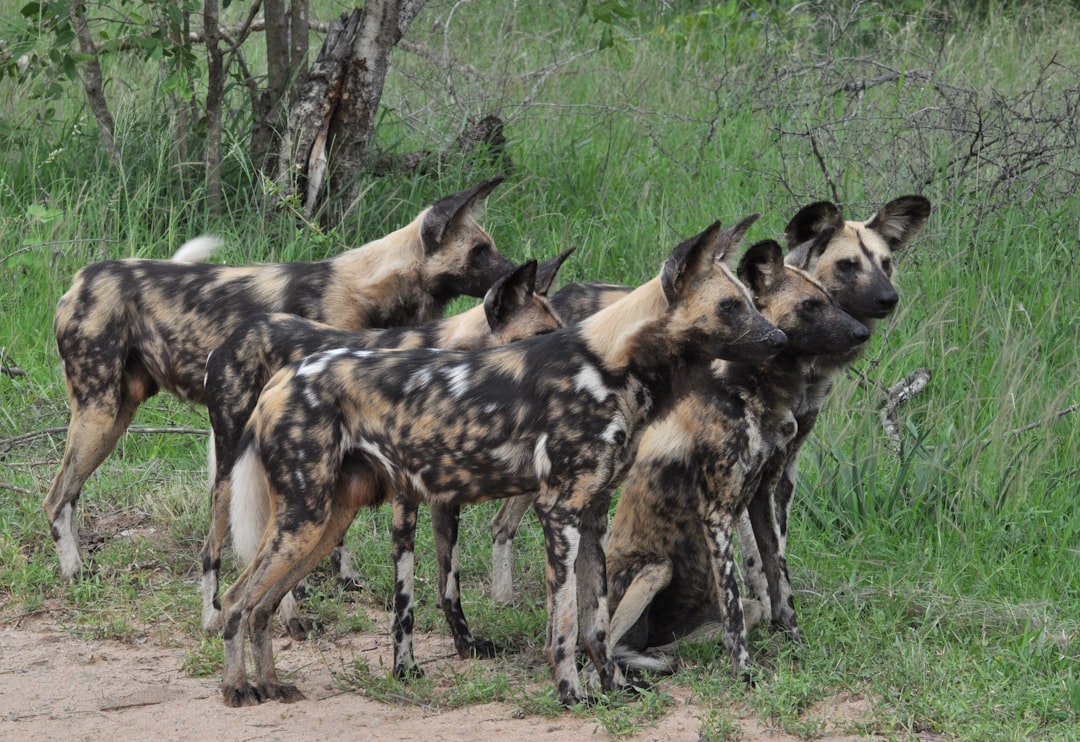
The Moremi-Khwai system supports multiple well-studied African wild dog packs, of one of the continent's most endangered large carnivores. Wild dog densities here are exceptional; encounters are not brief sightings but sustained engagement with packs habituated to vehicles, particularly during the May-July denning season when the pack anchors to a specific underground den site with new pups. Leopards in the riverine forests are unusually relaxed around vehicles. Lions, elephant, buffalo, and the full Delta-edge predator-prey complement complete the picture.
The Khwai community concession on Moremi's northern boundary is the destination's other half. Khwai is community-managed (200,000 hectares operated for the benefit of the Khwai village community) and operates outside national-park constraints: off-road tracking is permitted, walking safaris are conducted, and the spotlit night drive reveals the nocturnal ecosystem that no national park can offer. Pangolin (one of Africa's rarest and most trafficked mammals) is sighted at Khwai with a regularity unmatched anywhere else; specific Khwai guides have built reputations for pangolin tracking. Aardvark, aardwolf, civet, genet, and the full nocturnal cast complete the night drive list. A combined Moremi-Khwai stay (3-5 nights) covering both the national reserve and the community concession is one of Botswana's most consistently rewarding safari itineraries.
Things to Do in Moremi Game Reserve & Khwai
Track wild dogs at the denning site
May-July denning is the optimal window. Packs anchor to specific den locations and adult dogs return several times a day. The reunion ceremony, the regurgitation feeding, and the pup play are among the most affecting wildlife behaviours in Africa to witness.
Take a Khwai night drive
The reason to choose Khwai over a national park camp. Spotlit drives after dinner reveal pangolin, aardvark, aardwolf, civet, genet, and the predator activity that intensifies after dark. Pangolin in particular is among the rarest mammal encounters available in Africa.
Game drive Moremi's Xakanaxa Lagoon
The classic reserve drive circuit. Large elephant concentrations, reliable leopard sightings in the riverine forest, lion prides, and the floodplain margins where wildlife concentrates during the dry season.
Walking safari with an armed guide
Two to four hours on foot through the riverine forest and woodland margins. Tracking, vegetation ecology, dung identification — the depth of bush understanding that vehicle drives skim past. Khwai operators have strong walking programmes.
Combine with the central Delta
The standard Botswana circuit pairs 3 nights at a central Delta camp (Mombo, Jao, Vumbura) with 3 nights in Moremi-Khwai. The two formats reveal entirely different sides of the Okavango system. Light aircraft transfers between camps are 20-30 minutes.
Skybeds sleep-out at Khwai
The most unusual accommodation in the Khwai concession. Elevated sleeping platforms under the open sky with private beds, accessed by ladder from the operating partner property. A single-night experience that consistently ranks as one of the most memorable in Botswana.
When to Visit Moremi Game Reserve & Khwai
Dry Season
May, October
The signature window. Wildlife concentrates around permanent water as the surrounding bush dries. The Khwai River frontage becomes the primary water source for vast tracts of woodland. June-July is cool and comfortable; August-October sees the heaviest pressure on water and the highest heat.
Wild Dog Denning
May, July
Wild dog packs anchor to specific underground den sites with new pups. The packs do not move far from the den for 2-3 months, making sustained encounters routine. The optimal window if wild dogs are a primary motivation. Cool, dry, comfortable for game viewing.
Green Season
November, March
Summer rains transform the bush into deep green. Migratory birds arrive in extraordinary numbers; calving triggers predator activity; lodge rates drop substantially. Wildlife disperses across the newly productive landscape, making tracking more active. Wild dog packs range widely outside denning.
Shoulder
April
Post-rain green flush combined with thinning vegetation and a building dry-season pattern. Wild dog denning begins. Lodge pricing has not yet hit peak. A strong choice for travellers wanting Moremi-Khwai at its best without maximum peak rates.
Getting to Moremi Game Reserve & Khwai
Most visitors fly in by light aircraft from Maun (MUB) — 15-25 minutes to camp airstrips inside or adjacent to Moremi and the Khwai concession. The standard charter networks (Mack Air, Wilderness Air, operator-specific transfers) handle inter-camp moves. Road access is possible from Maun via the South Gate, North Gate, or Khwai community entrance (3-5 hours on rough sandy tracks; 4WD with significant clearance mandatory). The Mababe Depression sand and Khwai River crossings require experience. Self-drive overlanders use the DWNP campsites inside Moremi or the budget campsites at Khwai village.
Where to Stay
Inside Moremi: Camp Moremi, Camp Xakanaxa, and Xakanaxa Camp offer reliable Big Five access at the Xakanaxa Lagoon position. In the Khwai community concession: Sable Alley and its sister properties Hyena Pan and Little Sable, Khwai Leadwood, Machaba Camp, and the unusual Skybeds elevated platforms cover the premium tier. Mid-range options include Magotho Campsite and Hyena Pan Tented Camp. Budget self-drive: Khwai Village Campsites (community-managed) and the DWNP campsites inside Moremi (Third Bridge, Xakanaxa, South Gate). All light-aircraft access enforces the standard 15-20kg soft-sided luggage limit.
Travel Tips for Moremi Game Reserve & Khwai
Frequently Asked Questions
- Moremi or the central Okavango Delta?
- Different experiences. Moremi-Khwai is Big Five with land-based predator focus, off-road tracking in Khwai, and the night drive ecosystem. The central Delta is mokoro and water-based wildlife with extraordinary predator densities on Chief's Island. The standard Botswana itinerary pairs them: 3 nights in each.
- When are wild dogs most reliably encountered?
- May to July, during denning, when packs anchor to underground den sites with new pups. The pack does not move far from the den for 2-3 months. Outside denning, packs range widely and tracking is less predictable, though encounters remain common.
- Is pangolin really sightable here?
- Yes, more reliably than almost anywhere else in Africa. The Khwai community concession's habitat combined with dedicated guide expertise produces pangolin sightings on a meaningful fraction of multi-night stays. Not guaranteed, but the most reliable place for it on the continent.
- What's the difference between Moremi reserve and the Khwai concession?
- Moremi is a national game reserve with the constraints of a national park: no off-road driving, no night drives, no walking inside the reserve. The Khwai concession is community-managed private land where off-road tracking, night drives, and walking are all permitted. The wildlife is the same; the activity range is fundamentally different.
Explore More, Moremi Game Reserve & Khwai
Things To Do
Plan Your Trip
More in Botswana
Okavango Delta
A vast inland delta where the Okavango River empties into the Kalahari Desert, creating 15,000 square kilometres of seasonal floodplains, pa…
Chobe National Park
The world's highest concentration of African elephants — around 120,000 across the greater Chobe ecosystem — drinks from the Chobe River eve…
Central Kalahari Game Reserve
At 52,800 square kilometres, the second-largest game reserve on earth. Black-maned Kalahari lions, cheetah hunting on open fossil valleys, S…
Makgadikgadi Pans
Twelve thousand square kilometres of salt pans, the remains of a prehistoric super-lake. Lunar landscapes for dry-season quad-biking, Africa…
Kgalagadi Transfrontier Park
A 38,000 km² transfrontier park spanning Botswana and South Africa. Rolling red Kalahari dunes, black-maned lion prides, brown hyena, and th…
Linyanti & Selinda Concessions
The private concessions between the Okavango Delta and Chobe — ultra-exclusive safari territory with extraordinary wild dog populations, mas…
Nxai Pan National Park
A fossil lakebed adjacent to the Makgadikgadi with open terrain ideal for cheetah hunting and the ancient cluster of baobabs painted by Thom…
Tsodilo Hills
A UNESCO World Heritage rock art site with over 4,500 paintings on four quartzite massifs rising from the flat Kalahari, the highest concent…
Tuli Block
Far eastern Botswana at the meeting of three countries. Sandstone cliffs, massive baobabs, large elephant herds, and Mashatu Game Reserve's …